Archive for the ‘Bombay’ Category
“Gaon mein koi choota bhi nahi hai”
Friday morning, August 23, I was taken aback hearing about the rape of a journalist in Mumbai. Social media was abuzz with people in shock that such a crime could still happen after all that we had witnessed a few months ago in Delhi.
The first thing that we need to change is the mindset that city X is safer than city Y. Maybe it was true 20 years ago. Not anymore. There are various reasons to it.
The first reason I can think of is the unprecedented migration that has been happening in India over the last two decades. I do not have any data to support it right now but it seems plausible that with the growth that has taken place in our cities over the past 15-20 years, we have witnessed people, of all classes and professions, moving around across the cities for jobs. Bangalore has software engineers from Delhi and Bombay while the security guards that I have met have mostly migrated from the east. Delhi has migrants from Tamil Nadu just as it has people from Bihar. The typical one-city guy, that stereotype is no more. Everyone is everywhere.
Secondly, the behavior of our society which I believe reflects our morals (or the lack of it) is more or less the same. Reason being that our morals, across geographies, have that common ground. Haryana and Tamil Nadu, states that have had little in common in terms of culture and language have witnessed numerous cases of honour killings. Moral policing in a town of, say, Uttar Pradesh, is more or less of the same brand that exists in the southern port city of Mangalore.
The only exception to the above two reasons could be India’s North East. Look closely and you will find the reasons — their culture is more open, a boy and a girl holding hands is not a social taboo. And largely, the movement of people for jobs from the rest of India to the North East, it is safe to assume, must be negligible (It has been mostly, east to north/west/south but not vice versa).
Before I go any further, I must tell a small story here that a friend shared with me a few months ago. He had gone to Goa on a holiday. One of those days, in the mornings when the beach was deserted and the shacks were just opening up, a shop-helper sort of a guy was opening a shop. Mornings in Goa beaches are usually sane, with less crowds and all. A few foreigner tourists, all women, were walking by. This guy, suddenly exults, gives a smile and positions himself to be ready for a series of “high-fives”. The ladies obliged, perhaps smiled too and moved on. After the ladies had left, this guy, happily proclaimed something to the effect – “Back in the village I never get to touch a lady and here? wow!” (“saala wahan gaon mein koi choota bhi nahi hai!”).
I hate generalizing but it seems that to me, people who do the ghastly crime of raping a woman, have tendencies like this guy had, only magnified a few times.
To be honest, I am a little surprised that all the “change” that I am hearing about on social and traditional media has something to do with the law, or the Government, or the policing. No one is looking at what could be driving a 20 year old guy to commit this ghastly crime. It is almost naive to think that a law or a stronger police force is the ultimate answer to this menace.
A few months ago, I was at the Bangalore town-hall to witness the protest and the candle light vigil that happened just after the Delhi rape. People demanded justice and justice for them meant that the state give capital punishment to those six men. With the Mumbai rape, people may still ask for a similar punishment as the outcry right now suggests. There have been equal (if not more) calls for a more stringent law that would deter someone to commit this heinous crime. While I think that a strong law is the need of the hour, I also believe that giving someone death for this crime would not really bring about the change we want, in the long run. If that had to work, our society must have learnt its lessons after the Delhi rape case. It has to be a combination of a stringent law AND a social change.
The social change that I talk about here is about not making a deal out of a boy and a girl holding hands. To not look at young, unmarried couples in contempt. To make it reasonable for a young unmarried couple to stay together. The urban society that we are so used to may have learnt to agree with it but there is a lot to India than just the few big cities. It is only when our villages and small towns come out of long held social but irrational beliefs would we be able to see a real change in our society.
Maybe then that guy in Goa will stop raising his hand for high-fives everytime he saw a group of white women on the beach.
On The Tales From Firozsha Baag
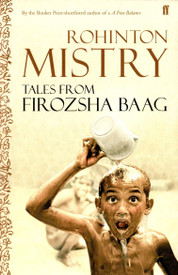
“A Fine Balance” by Rohinton Mistry is one of the finest (probably only surpassed by Rushdie’s Midnight’s Children) Indian literary novels ever. There have been very few books that have touched my heart as it did. I was new to Bangalore, in 2005 and was looking forward, with a book in hand, to getting lost in the myriad of lanes that the city had to offer.
A writer friend I constantly look up to, once suggested that “Tales from Firozsha Baag”, Mistry’s debut, was a great book and his personal favorite. I had the opportunity to read the book over the last couple of months. As it turns out, as debut books do, this one not only gives enough hints of the great writer that Mistry would turn out to be but it is a masterpiece in it’s own right. Here’s a small para I loved for the sheer prose of it, describing the Bombay local train scene in all it’s essence:
The suburban local was at the outskirts of Bombay; they would arrive at their destination in forty-five minutes. The ’17 Standees Allowed’ by the scratched and peeling sign had already been exceeded by the crush of Sunday morning commuters, but not to the extent of a weekday train: as yet, there were no roof-riders or window-clingers. In the sky the sun was higher than the when the train left Bombay Central. The heat began to strengthen rapidly now, seeming to feed on itself, growing more oppressive with every breath. From metal straps hung the standees, listless, upraised arms revealing identical damp patches under sleeves of shirts and blouses. Overhead, the fans turned ineffectively, whirring and rattling, their blades labouring with feeble rotations, trying to chop the air thick with heat and odour, scattering it around unelessly in the compartment.
The book is a collection of eleven short stories set in the 1980s about people living in a parsi colony in Bombay. The stories are intertwined while each story has a main subject/family and at least a few characters from other stories make appearances in each story.
As any good book would, this takes a little time to pick up even though the stories by themselves are distinct. But then again, with Mistry, it is not so much about the story but the beautiful prose that he weaves with his simple tools that comprise mostly of words. At times, the stories have an element of shock, but are mostly amusing and sometimes even funny but the common thread that binds them all is the pettiness that was the common ingredient that every middle class family in Bombay must have had in the 1980s — something I could relate to, for I grew up near Bombay at the same time and have seen the city at close quarters.
Consider for example, the story called Squatter in which Nariman Hansotia, a man popular with kids of Firozsha Baag for telling stories tells the story of an imaginary cricketer named Savukshaw, the greatest cricketer who played during the times of greats like Umrigar, Contractor and Farokh Engineer. Savukshaw, who gave up cricket for cycling, before he became a pole-vaulter and then a hunter could never find happiness in his life. Eventually Mistry, with Nariman at his aide, tells us about Sarosh, living in Toronto for ten years and yet not being able to balance himself on the western commode. So Sarosh, throws himself a challenge and what follows is a funny account of an Indian immigrant’s life in the first world.
Or one could keep thinking about Lend Me Your Light, where the lives of three friends, one of them, the narrator, the other being his brother and the third, a friend, keep crossing each other’s at intervals. Nothing much would have come of it if only the three would not have spent their childhood together. The story depicts how, in the 1980s, the Indian Youth reacted to the hopelessness surrounding the times. But then again, it is not so much about the story but in this case, it is the difficult questions that Mistry asks his readers by way of the characters he beautifully crafts, at will. It is this rush of emotions that these subjects feel and you, the reader, would find yourself inevitably attracted to these viewpoints, almost agreeing to one of them, and maybe taking out time, thinking and answering these uncomfortable questions, looking out ways to possibly ensure that your well-thought of answers that you mumble quietly within the vicinity of your head are somewhere heard. It is what any well told story should do to you, and this one most certainly qualifies for one, as it continues to dwell, this story of three boys growing up to men, living in different lands — Toronto, New York and a small village in Maharashtra but returning home to Bombay with a different set of emotions each time.
Or maybe I could also talk about the last story, if I can call it that, because Swimming Lessons has distinctive details about the author’s own life (More on that later). Here Mistry goes back and forth between the central character of the story who grew up in Firozsha Baag but finds himself in a Toronto apartment while his parents wait for his letters in India. The Toronto version of events turn out to be about his daily experiences where he recounts his childhood with minute details while the events that happen with his parents (presumably set a little in the future) talk about letters that his parents keep receiving only to find, inevitably to his father’s disappointment, a standard paragraph on weather from their son in Toronto who refuses to divulge details about his daily life without asking any in return until one day they find that their son, in a clerical job with an insurance company in Toronto, is also a writer and has written a book of short stories on his childhood experiences of Firozsha Baag! (Mistry was a banker until he started writing in his late 20s/early 30s)
The story is a joy to read with segments of hopelessness coupled with antidotes on what could become a writer, coming from the father’s perspective who is much delighted now that his son has found his calling in writing. And now, with the way of his father’s dialogue, Mistry conveys to us some theories that are heartening to hear for any aspiring writer. Consider some excerpts:
all writers worked in the same way, they used their memories and experiences and made stories out of them, changing some things, adding some, imagining some, all writers were very good at remembering details of their lives.
And:
Father explained it takes a writer about ten years time after an experience before he is able to use it in his writing, it takes that long to be absorbed internally and understood, thought out and thought about, over and over gain, he haunts it and it haunts him if it is valuable enough, till the writer is comfortable with it to be able to use it as he wants; but this is only one theory I read somewhere, it may or may not be true.
Ah no, I am not much of a writer but I can see why I keep remembering the past so often. Maybe I miss it so much and that I try to relive the experience by writing about it and talking about it in fine detail, as much as I can, as much as I can afford and as long as I have an audience. Maybe I should start using my memories of growing up on an island near Bombay to good effect. Anyway.
So the stories go on but with Squatter, Lend Me Your Light and Swimming Lessons, Mistry saves the best for the last. I wish I could mention more stories but that would be telling too much. Like the taste of filter coffee, the stories linger on long after you are done reading it.
Convenient Stereotyping
One of the things that I fail to understand, and I have asked myself this a few times, is that why is Goa shown in a light so different than what it really is, by the Bombay Film Industry? Before you jump to conclusions, let me say that I did not mean that the movies show Goa in a bad light, I said that they show what is not true at all, most of the times.
It seems people from Goa have been a victim of stereotyping, something that Bollywood does often. Goans are not the only ones which are generalised. The film industry time and again has given in to the temptations of generalisation. A Goan Catholic will be a drunkard, a sardar would eat chicken with a patiala peg everyday and would be ready to break into a bhangara jig at the slightest of excuse, a muslim man would speak impeccable urdu which would be so much different than Hindustani, which we commonly speak in India (sprinkled generously with English of course) and a Tamil Brahman (if you find one in a Hindi movie), would end every line with a “jee” and exclaim “aiyo!” after every couple of sentences.
So if the latest bollywood film claims that Women are cheaper than liquor in Goa, I would say that this is nothing much but an extension of Bollywood’s convenient stereotyping. Bollywood’s relation with Goa goes beyond stereotyping the typical Goan Roman Catholic to a drunkard. Hindi movies give Goa it’s rightful place as a holiday destination. But not all people go to a holiday to get drunk. Not all people go to Goa and get drunk. There are teetotallers in Goa (I am one, though I am not a Goan but hey I have home there). Bollywood takes it’s actors to Mauritius, shows bikini clad women and clear water on the shore, the lead actors get cosy in a song and that’s all packaged in a 15 minute sequence and sold as Goa. Whats more, the audience is naive enough to believe that Goan women are easy, roam around in bikinis while their men booze all day.
I honestly don’t see much in Basu’s dialogue. As I said, it is basically something they have tried to build up on an already existing platform that has been made by generalising Goa over the years. When they have repeatedly marked cheap liquor and drug peddling as Goan brands, could prostitution be too far behind? For them, it’s a complete package. The pity is, there is a section of naive audience out there, who’d believe it.
Bollywood’s breaking free of this convenient stereotyping would help, though.
A year after
One year since the November 26 2008 carnage that happened in Mumbai and we have already found more important things to talk about.
We have, for example, witnessed a “furore in the House” (as promised) when one MLA chose to take his oath in another language but Marathi. We witnessed how a few elected to the office by the people can transform into goondas as and when convenient.
If only all the promises were kept and taken in the same vain by them who were making them, our country would have been a much better place to live in.
We have also witnessed a national hero proclaiming that He is proud to be a Maharashtrian but reinstated that Mumbai is of whole India. As always, he got his priorities right but then we also witnessed the grand old man, the self-proclaimed big daddy of the Marathi Manoos, telling the former that his comments had hurt, no prizes for guessing who, the Marathi Manoos.
Never has the “Proud to be an Indian” comment raised so much controversy.
Then, of course, we also know that calling the city “Bombay” (and not “Mumbai”) can get you thrown out of the city limits.
This is November 26, a year after. Of prime importance, these things.
Postscript: Coming in just now, the political party that owns the goondas who fulfilled the promise mentioned above has put up a hoarding in Mahim paying homage to the martyrs of 26/11. But only the Marathi Manoos among those heroes find a space there. Bangalore’s Major Unnikrishnan and Dehra Dun’s Hawaldar Bisht have been conveniently forgotten — their sins being that they were not the Marathi Manoos. Look at the picture here and you will notice, the political heroes who have put this hoarding up have their own faces enlarged on the poster — larger than the faces of the people they are supposedly paying homage to.
As it ought to be
My earliest memory of Bombay is also the most amusing one. My mother and father taking turns holding my sister and I holding one of them by the hand, standing on the overbridge of Ghatkopar station, pointing our gaze at the far end of the rail tracks, trying to ascertain which platform the coming train will ply on. If someone ever tried to find out a method to Bombay’s madness, here was one. At that moment, when all of us, despite everything, boarded the train, Bombay was an overcoming of obstacles.
The usual journey that took us to Bombay from the suburb we lived in involved a 45 minute boat ride, a walk through the Naval dockyard, a taxi ride, a train to be caught from the majestic Victoria Terminus. In monsoons, it was mostly an ordeal — much before we could make our ways through the Bombay roads that were full of filth and mire, we had to deal with the rough seas. But this fortnightly trip was something that had to be undertaken, for we lived in a place that was much away from the mainland. And going to the home of my father’s aunt — our only relation in Bombay, was a journey that was very comprehensive and offered me the only glimpse of a world that was so different than the one where I lived, only a few miles away. Then, Bombay was a collection of life’s first few lessons.
But the most rewarding of all was when I used to go to Bombay with my mother. She loved to windowshop at Crawford market (deep inside she still does, I know). We roamed around the fountain area, picked up some casual clothing and windowshopped at the costly stores. During one of those trips, I was amazed, almost to an extent of being in shock, to the sight of two glass doors opening (and closing) automatically as I stepped into a (very posh) Vimal Cloth Store. It was probably man’s greatest achievement, I thought — a technical feat. Oh and I almost forgot to mention the reward involved — the “softy” we called it then, the ice-cream cone that my mother treated me to. It was nothing less than a bribe. Getting it was not so easy — I had to keep my mouth shut while mom took her time choosing clothes. And on the rare occasion that I was extra good at it, I got twice of what was promised. At that very moment, Bombay became rewarding.
Slums were to be seen for the most part of the train journey. And there were different smells. A sea of smells. The smell of dried fish, the salty air. The city still retains most of it. Ah yes, the slums. They were just there, as if they had been there always. I never thought of them then — See, I was coming out of my shell and what I saw then was my idea of the world. So there it was, that another world alongside the railway tracks. The two worlds, by and large, living coherently.
So it comes as a surprise to me when they continue to derive so many things out of the slums. Spirit. Coherence. Unity. Tolerance. Pick up anything. Any movie, any literature on this city and you will find something or the other of the just mentioned coming out. Midnight’s Children, A Fine Balance, Salaam Bombay, Shantaram, Dharavi and the most recent, Slumdog Millionaire –each one of them a masterpiece. But why do we need to be reminded, by these works of art all based in Bombay’s slums, that religious tolerance and staying together are lessons that can be derived from an ordinary life?
At that time, for a 10 year old boy, Bombay was nothing extraordinary. It was just as things ought to be.