Archive for the ‘Society’ Category
Being Indian
The latest Prime Minister’s comments that evoked a strong reaction on the social media were said in not one, but two countries – China and South Korea.
This cannot be impromptu talk. These are well thought of comments and the politician that he is, our PM must have analyzed the impact these words would make before stepping on the podium. Anyway, that is beside the point.
Writer friend Dilip D tweeted my exact thoughts, which went like, Mr PM, please speak for yourself, not me. Then I tweeted about it – that I am supposed to be feeling ashamed of being born an Indian, as per our PM and now, for the last one year since he has assumed office, I am supposed to be proud of it. To which my friend M asked me my “final feeling” about it all (It was amusing, I admit, that phrase, “Final feeling”). A barrage of thoughts later I realized that I had no idea on what to answer her.
My first thought was, there’s no black and white here. There is vagueness, a bit of confusion. I thought I wasn’t ashamed of it – of being an Indian but was there pride? If yes, about what? History? Of what we have achieved in the past 20 odd years that I have witnessed and remember of? I did not know an answer to that. I asked her back the same thing and she told me a similar sentiment.
So I thought, lets think about pride and what it means to most of us.
Wanting to give this a fresh thought again, I realized eventually that to have an answer to this confusion, one needs to decide on what is actually meant when one says “Indian” (or “Being Indian”). My conclusion about it was that we confuse ethnicity Indian with citizen Indian (which eventually leads to our idea of nationalism that leads to patriotism and what not). Ethnicity adds a new dimension. With ethnicity, there is suddenly a few thousand years old history and culture. Are we all proud of that? Aren’t we all taught to be proud of that?
I spoke about this, the same evening with my friend A, who is a Malay (and a Malaysian). I asked her the same question but from her point of view. Her reaction was: why should one be proud of one’s history/culture? Who gives you that right? I am just born here, something I had no control on, in this ethnicity which has such and such culture so why should I take credit for it? Why should one be proud of what one’s ancestors did? One can be impressed by it, be in awe of it but we should not confuse that with pride.
Let me explain as my friend did: If a friend I know does something really cool, you say, “I’m proud of you”. It does not mean that hey, you did this, I wish I’d done the same and SO I’m proud of you. It probably has something to do with your decision of befriending this person, which is rather justified by something that s/he has done. You have to DO something (in this case, make a decision and befriend someone) to be able to take pride in something. With your ethnicity/culture, you haven’t done anything – unless you are someone who changed the course of your race. You were just born there, which as much as you’d hate to say it aloud, was a matter of chance and nothing more. You have no right to be proud of it.
That was the gist of our discussion. And to me, it completely made sense.
Later that evening (Long evening, I know) I spoke about this with another friend who I went to college with and his thoughts about pride and shame were exactly the same as the other friends I had spoken to. This is by no means a sample size enough for a survey but these people, what they think, it matters to me.
So, as far as being Indian as a race, ethnicity, culture and what-not is concerned, no, rationally, you can’t be proud of it. That leaves us with Indian – the citizen. You can take a call on that. But remember, the Government is not the country. Yes, it generally is a clear reflection of the people of the country and the people get the Government they deserve but overall, it is NOT the country. Then who is? People?
Last but not the least – one of the gems that came out of this discussion was an article written by the great Khushwant Singh that answers EXACTLY the question. In his usual candid way, our dear writer makes it look so easy. Here.
“Gaon mein koi choota bhi nahi hai”
Friday morning, August 23, I was taken aback hearing about the rape of a journalist in Mumbai. Social media was abuzz with people in shock that such a crime could still happen after all that we had witnessed a few months ago in Delhi.
The first thing that we need to change is the mindset that city X is safer than city Y. Maybe it was true 20 years ago. Not anymore. There are various reasons to it.
The first reason I can think of is the unprecedented migration that has been happening in India over the last two decades. I do not have any data to support it right now but it seems plausible that with the growth that has taken place in our cities over the past 15-20 years, we have witnessed people, of all classes and professions, moving around across the cities for jobs. Bangalore has software engineers from Delhi and Bombay while the security guards that I have met have mostly migrated from the east. Delhi has migrants from Tamil Nadu just as it has people from Bihar. The typical one-city guy, that stereotype is no more. Everyone is everywhere.
Secondly, the behavior of our society which I believe reflects our morals (or the lack of it) is more or less the same. Reason being that our morals, across geographies, have that common ground. Haryana and Tamil Nadu, states that have had little in common in terms of culture and language have witnessed numerous cases of honour killings. Moral policing in a town of, say, Uttar Pradesh, is more or less of the same brand that exists in the southern port city of Mangalore.
The only exception to the above two reasons could be India’s North East. Look closely and you will find the reasons — their culture is more open, a boy and a girl holding hands is not a social taboo. And largely, the movement of people for jobs from the rest of India to the North East, it is safe to assume, must be negligible (It has been mostly, east to north/west/south but not vice versa).
Before I go any further, I must tell a small story here that a friend shared with me a few months ago. He had gone to Goa on a holiday. One of those days, in the mornings when the beach was deserted and the shacks were just opening up, a shop-helper sort of a guy was opening a shop. Mornings in Goa beaches are usually sane, with less crowds and all. A few foreigner tourists, all women, were walking by. This guy, suddenly exults, gives a smile and positions himself to be ready for a series of “high-fives”. The ladies obliged, perhaps smiled too and moved on. After the ladies had left, this guy, happily proclaimed something to the effect – “Back in the village I never get to touch a lady and here? wow!” (“saala wahan gaon mein koi choota bhi nahi hai!”).
I hate generalizing but it seems that to me, people who do the ghastly crime of raping a woman, have tendencies like this guy had, only magnified a few times.
To be honest, I am a little surprised that all the “change” that I am hearing about on social and traditional media has something to do with the law, or the Government, or the policing. No one is looking at what could be driving a 20 year old guy to commit this ghastly crime. It is almost naive to think that a law or a stronger police force is the ultimate answer to this menace.
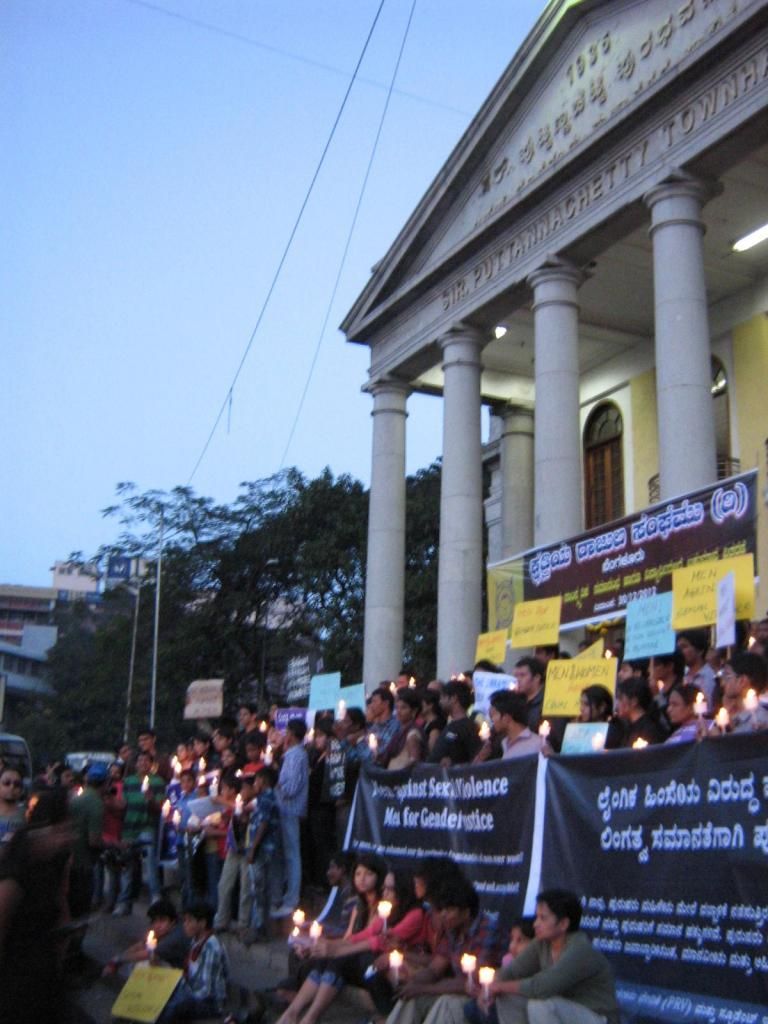
A few months ago, I was at the Bangalore town-hall to witness the protest and the candle light vigil that happened just after the Delhi rape. People demanded justice and justice for them meant that the state give capital punishment to those six men. With the Mumbai rape, people may still ask for a similar punishment as the outcry right now suggests. There have been equal (if not more) calls for a more stringent law that would deter someone to commit this heinous crime. While I think that a strong law is the need of the hour, I also believe that giving someone death for this crime would not really bring about the change we want, in the long run. If that had to work, our society must have learnt its lessons after the Delhi rape case. It has to be a combination of a stringent law AND a social change.
The social change that I talk about here is about not making a deal out of a boy and a girl holding hands. To not look at young, unmarried couples in contempt. To make it reasonable for a young unmarried couple to stay together. The urban society that we are so used to may have learnt to agree with it but there is a lot to India than just the few big cities. It is only when our villages and small towns come out of long held social but irrational beliefs would we be able to see a real change in our society.
Maybe then that guy in Goa will stop raising his hand for high-fives everytime he saw a group of white women on the beach.
Protests in Bangalore
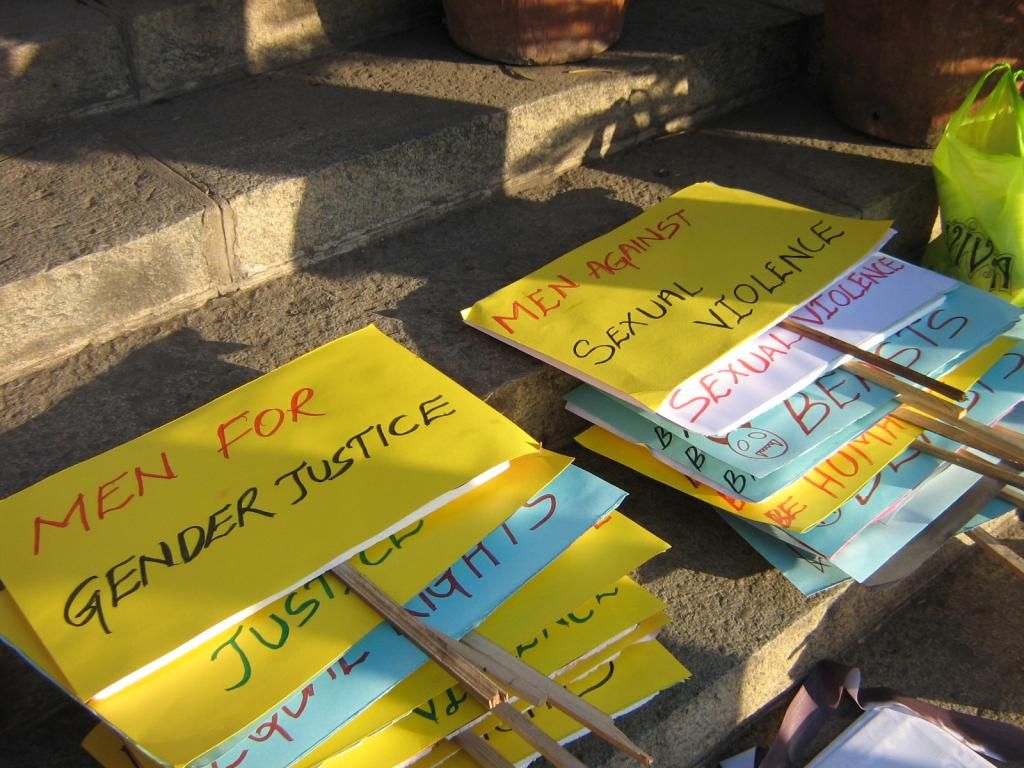
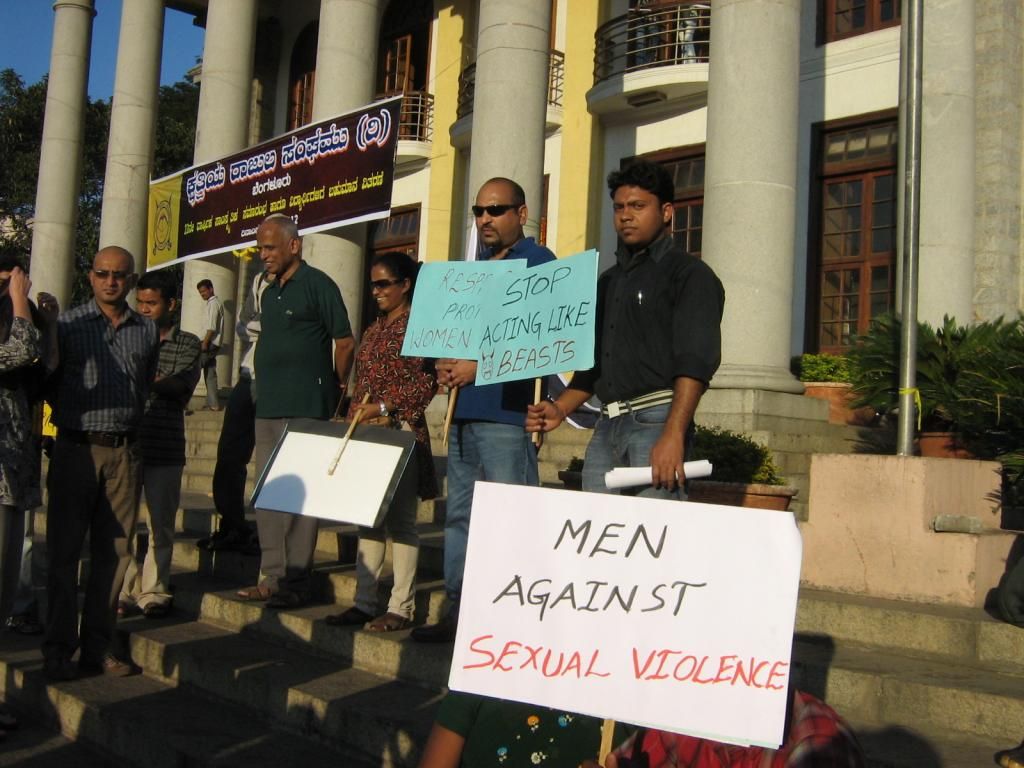
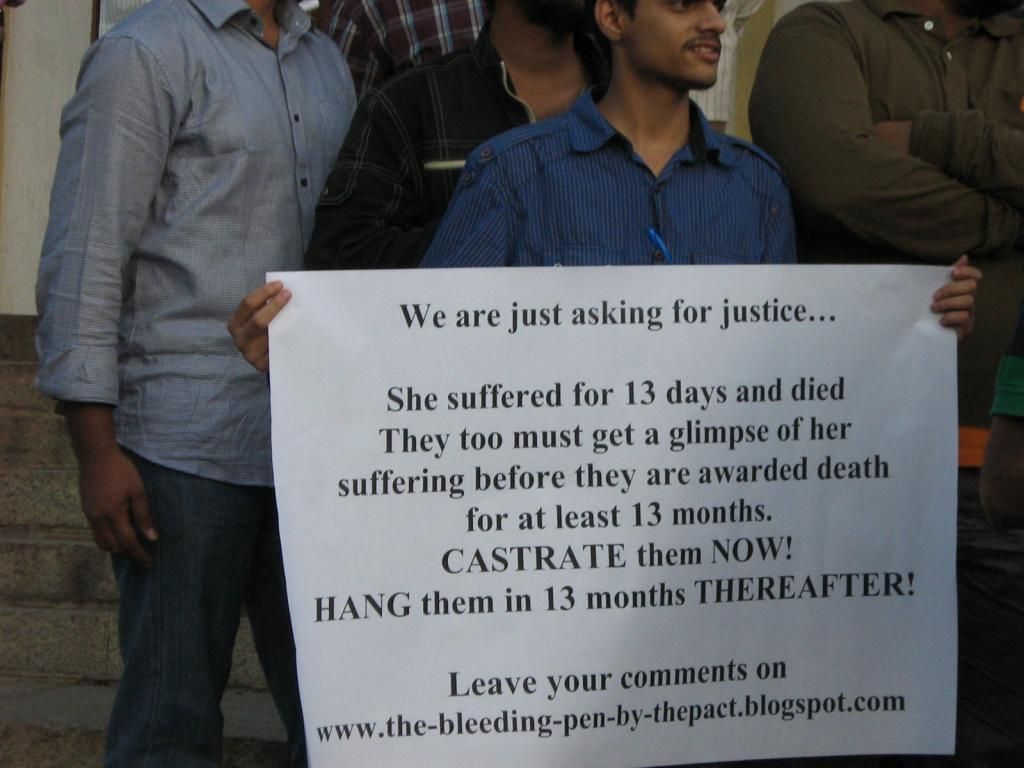
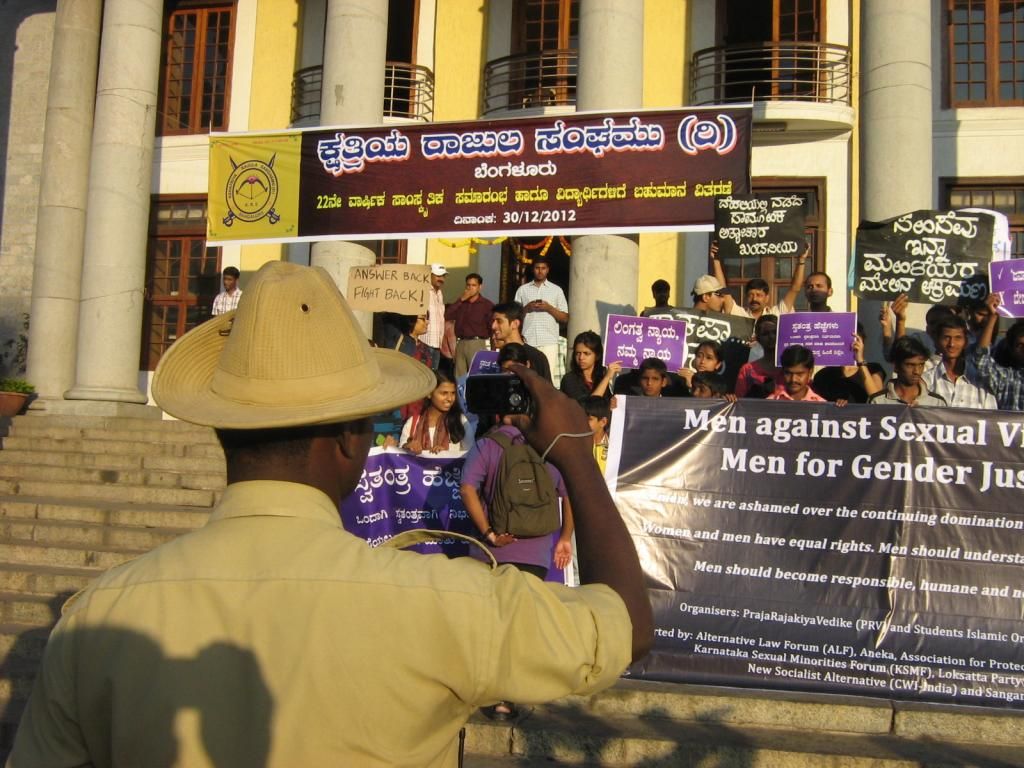
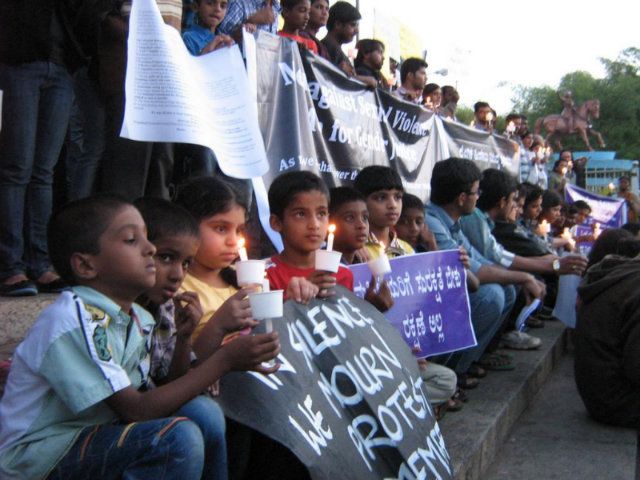
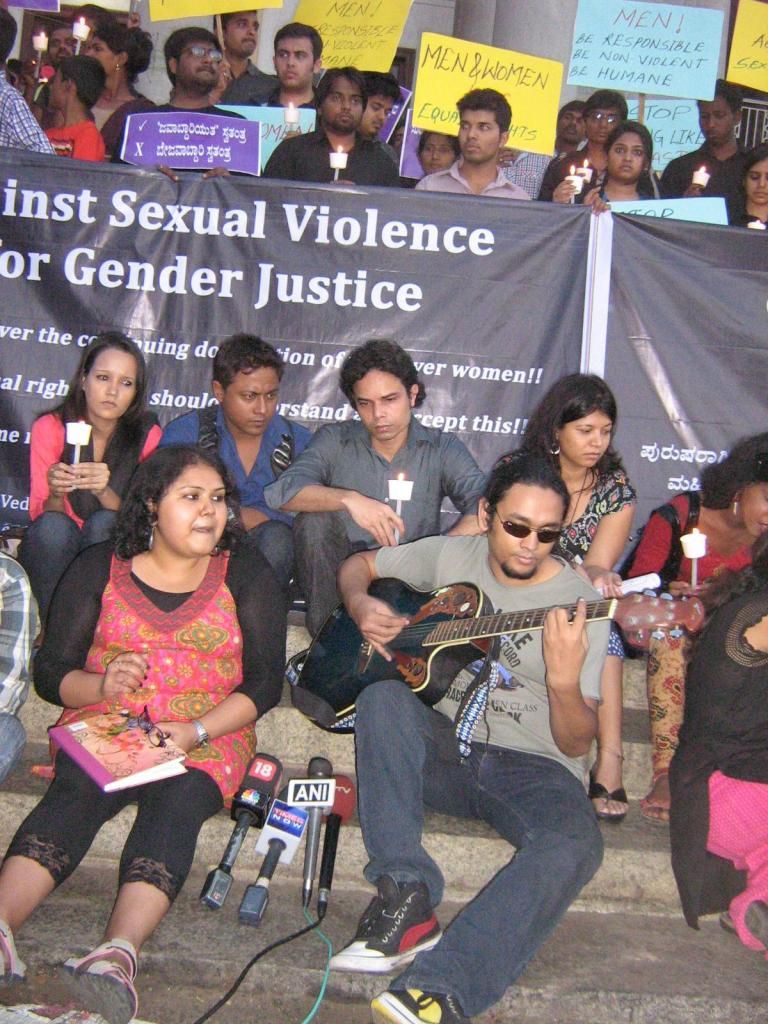
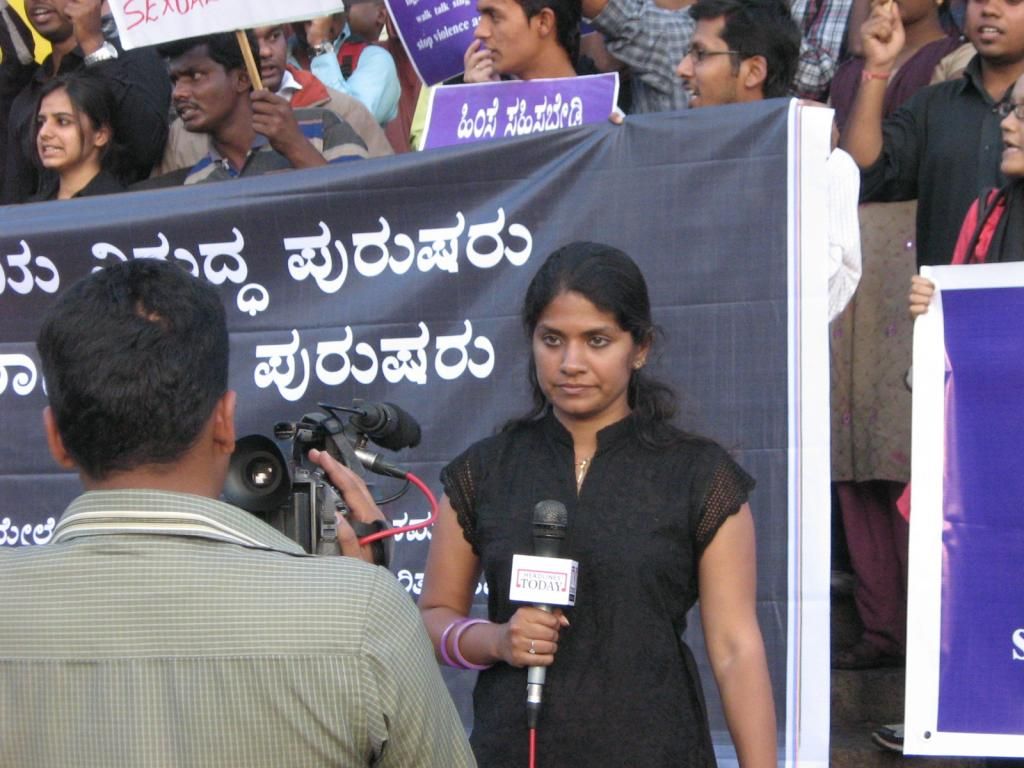
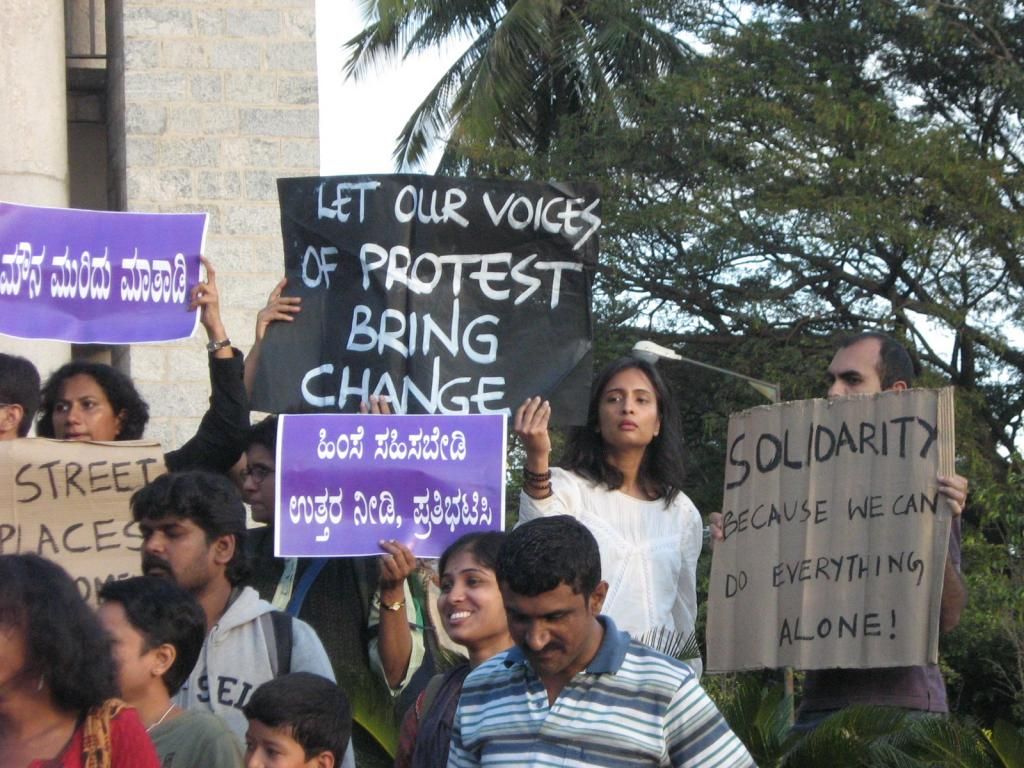
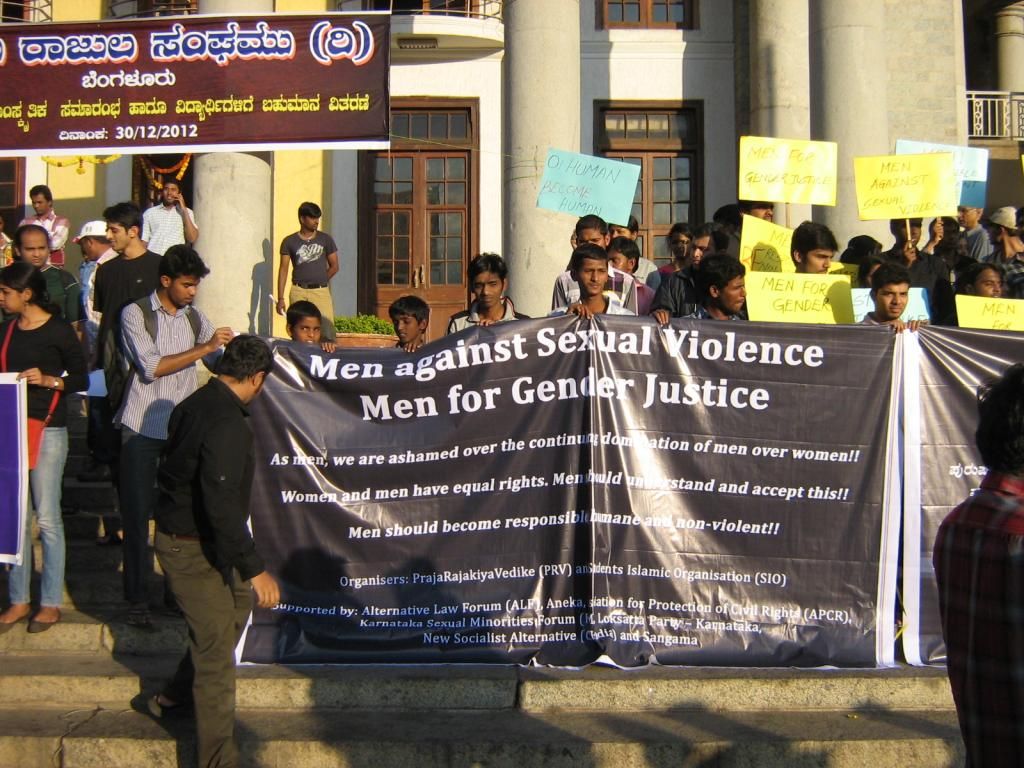
Today evening, in Bangalore, there was a silent protest and a candle light vigil at the Town Hall. It was heart warming to see a lot of men turning up. There were banners mentioning the Delhi gang rape and the 23-year old woman, whose death has shaken up our souls and there was at least one banner asking for the death of those responsible but there were also banners that asked for changes at the social level. Not capital punishment, not a new law but a change in ourselves — in how our society, and its men treat women.
I guess this was quite unlike the protests in Delhi, where they have been mostly attributing justice with the killing of those six men. I personally believe that though capital punishment may calm public’s anger over this heinous crime — it is social change that will eventually prove to be the catalyst for everlasting betterment of our lives.
Unless we ask for that social change, things may be the same. And for that change to happen, we may not even need to take the streets and blame the Government (as we have become used to doing it for sometime now). So the answers to most of the the evils that ail us may not be on the streets but in our own backyards. We just need to look.
Here are some of the pictures that best describe the emotional scenes there at the Town Hall.
(PS: My blog’s template does not allow big pictures to be displayed properly. You may please click on the pictures to see them in their entirety)
SMS Y to 5782711
Do you remember the time, not long ago, when people, at least here in Bangalore, formed human chains? When they had fancy stickers on the mudguard of their bikes, at the back of their cars, wearing black on a certain day while proclaiming their love and support for a man who they had never heard about ever before? Besides the things people did to show the support, there was one thing constantly making rounds: If you indeed supported him and really wanted the bill, his bill, to be made into a law, a piece of paper that could suddenly transform the times that we live in, for better or for worse only God can tell, you had to give a missed call. Yes. A missed call.
Anna Hazare asked the country for a missed call (A far cry from Subhas Bose’s demand for blood in return for freedom but hey, this is 2012). And we all obliged.
Hazare did something that no one in recent times could. Of all things, rekindled that fire, channeled that anger. We all had always thought that we deserve better politicians, now we were sure. But somewhere he also managed to create a beast out of the whole political system and made us believe that this external entity, this bad thing that could bite us all off, had to be tamed and put on a leash. We were our own heroes, the good guys. Those holding office, those ministers, the bad guys.
So we continued to live our lives as we always had. On one hand we put pictures of Hazare on our car bumpers and on the other we bribed traffic policemen, registrars, brokers and everyone else who could make our lives a little easier than standing in queues or visiting courts. But yes, we always were proud of supporting Hazare, our demand for that bill that most of us never bothered to discuss the internals of, forming human chains and giving missed calls.
And now we would be continuing our good deeds every sunday morning. Just like we believed Hazare would eradicate corruption, Aamir Khan has arrived with a bang to put a full stop to all social evils, one evil at a time, every week. The convenient time of a lazy sunday morning: all we would need is to press “Y” and send an sms — that’s it.
Did that just sound that I am against Satyameva Jayate? To many it did. Well, here’s my credo: I believe Anna Hazare and Aamir Khan have done all within their power to bring about a change. But I also believe that social evils can’t vanish when a celebrity hosts a tv show or writes a letter to a state’s chief minister.
I went about, asking people, about this change they were expecting. I was given many examples, quotes that startled me — like compared to America, there’s no incentive to be honest here. I have pondered on this for sometime but I can’t understand, why would someone need an incentive to be honest? And if that indeed holds good, lets say it has merit for we have an argument at stake, won’t you understand if your local politician comes up with a mini-scam?
And then there’s this golden excuse: Let them at the top change first. A top-down approach: The change for the good should begin at the top, why bother until then?
There will be many times in our lives when we are not on a couch and when it’s not a sunday morning, when we are not thinking of Aamir Khan that we’ll have two choices: one would be easy, all we would need to do is look the other way and the other would be tough, way out of our comfort zone. If for once, when we choose not to look the other way and take that tough call, we would have made an impact to our society in our own way.
So, Power to Aamir Khan and his show. But an “SMS Y to 5782711” will only take us so far.
How do you support Mr.Hazare?
A few days after Anna Hazare’s now infamous April 5 Hunger strike, I saw a car, in the posh Koramangala neighborhood, with the sticker “I support Anna Hazare”. Instinctively, I wanted to run after the car, have a glimpse of the person behind the wheel and ask: Sir, how exactly do you intend to support Mr. Hazare? I didn’t do it; the thought came a few seconds too late while the car gained momentum.
In August, during the time when Hazare was in jail, various rallies were organized in the city. There was the gathering at Freedom Park. Some people decided to wear black on certain days. Some of them burnt effigies and had mashals in their hand while they carried a portrait of Hazare (with the Mahatma in the background). One evening, I witnessed one such rally in Koramangala, with people chanting slogans in the name of Hazare.
The same evening, not very far away from where I had seen this rally and strikingly close to where once I had seen this car with “I support Anna Hazare” sticker, I saw three traffic policemen manning a junction. One man, his two-wheeler parked by the side, on the broken pavement, with a bunch of notes in his fist. The officer had a firm grip on what lay inside his fist while the man was trying to free his arm, in vain. I do not know if I was alone in this but I certainly felt some irony witnessing this scene with the Hazare rally in the backdrop. That a group of Hazare supporters crossed the same busy Koramangala intersection at almost the same time must have done little to sanctify the surroundings and the scene.
A few weeks later on the same location, I saw the same policemen. This time they were preying on the two-wheeler riders that came on the wrong side of the road. 15 minutes later, I had spoken to two of their “victims”, both of them who chuckled while they told me they had just “paid up”. There was even a broker, as they told me, who helped bridge the linguistic barrier while negotiating deals.
Keeping Hazare and India’s fight against corruption in background, let me talk about a few other instances.
In one of the sub-registrar’s office, my wife had to pay a fee of Rs.200 for a stamp on a document. Until asked for, she never got any acknowledgement for the amount paid. When asked, she got frowns and was given directions to various windows across the office until someone obliged with the receipt (but not without giving a nasty glare). In another sub-registrar’s office in Bangalore, they reject your property registration if a bribe of Rs.14000 (for a standard area plot) is not paid (cash, of course) with your application fee.
Another day, on the way back from work in an auto-rickshaw, stuck in the evening traffic jam at Koramangala inner ring road, I saw an argument between a pedestrian, who had been walking on the pavement and a rider who had his two-wheeler on it. Now, Koramangala inner ring road is not the typical Bangalore road. For a 3 km stretch, there’s no shelter on either side of the road, only green bushes in an army land that encompasses both sides of the road. The road also has a slightly elevated pavement, all the way. That rainy evening and with that traffic jam that’s such a common occurrence, the rider, in a bid to outclass the lesser mortals using the road, had ventured into pedestrian territory and now wanted the pedestrian to make way for him. Only that the pedestrian was hell bent on not giving him room to pass. “This is for pedestrians. If you have to go, you hit me and go”, shouted the pedestrian, looking back, blocking the way. The rider, in return — with rage in his eyes, threatened to beat the pedestrian up.
Times like these, I end up thinking of the Koramangala car with it’s “I support Anna Hazare” sticker and my intention to ask that question. Admittedly, I have asked the same question to many of those who chose to wear black and were a part of human chains or went to Freedom Park. In most cases, the answer was simply that they planned to support Hazare by forwarding emails, giving missed calls, sharing videos. This way, many said, awareness will be increased. Many also believed that by doing this, they would be “morally” supporting Hazare.
Talking about Hazare: My problem with Hazare and his team is simply that they have projected the politicians and the people who hold state power as a completely different breed from us. It is like a giant beast that needs to be put on a leash. The lokpal bill, for now, is our projection of that leash. While creating this image, we – the citizens, have completely absolved ourselves of even, at least, trying to live our own lives in honesty and driven by moralistic values. The truth is, a society gets the Government it deserves.
In that regard, destiny has served us well.
If something in us instinctively makes us break the most simplest of laws that we can adhere to (and that includes our daily tryst with traffic signals), what right do we have to expect those who yield power in the State to be clean and models of honesty?
All these people: The policemen manning the Koramangala intersection, those who confessed that they paid bribes to the policemen, the two wheeler rider who had the audacity to drive his bike on a 3 km long pedestrian pavement and then threatning to beat up the pedestrian, those officers and clerks in various sub-registrar offices in Bangalore and the rest of us who use our own discretion while deciding to break red-signals — I am certain, all of them would say “yes” in unison if Hazare asked them their support in his movement. All of them are, afterall, fed up of a corrupt Government that runs this country.
But my question to them is – How can we claim to give moral support to a movement against corruption and be immoral at the same time?
This culture of arbitrariness
From rediff’s article here, this quote:
“I don’t understand why the president of this country, who is the supreme commander of the army, doesn’t issue orders to shoot people like Prashant Bhushan. Anyway, we, the people of this country have some responsibility and we will teach him a lesson.”
I won’t quiz you around about who said these lines: Inder Verma, 24, self-proclaimed president of the State unit of Sri Ram Sene, who attacked Prashant Bhushan in his chambers within the court premises in New Delhi, earlier today (btw, this is the same Sri Ram Sene that once beat ladies entering a pub in Mangalore).
Apparently Mr Verma and his friends did not agree with some of the views Mr.Bhushan, a Supreme Court lawyer and a close member of the Anna Hazare group, had about Kashmir and Kashmiris. So they decided to tell a lie, gain access to his chambers in the court and beat him. Very convenient. This is a situation similar to when you and I have a disagreement on certain things. And then I decide to “teach you a lesson” – I enter your office and beat you up. If this does not enrage you, nothing will.
Anyway. These kids also threw away a bunch of pamphlets around. The last line goes:
“Frustrated from traitors and anti-nationals and motivated from A Wednesday movie” (sic).
I won’t say much but this is exactly the reason I have grown to loathe movies like “A Wednesday” and RDB (though elsewhere on this blog I once seemed to have an opinion that it’s a movie worthy of a watch, not anymore). In “A Wednesday”, Naseeruddin Shah’s character decides to “teach a lesson” to the Government and the Police, which includes detonating a few bombs at will. In RDB, of course, a few college kids also decide to teach the neta a lesson, the movie ending with the kids on a killing spree.
You can’t ban these movies. But the problem starts when people start taking inspiration from these flicks. Today, armed with a lie, Inder Kumar and his bunch of goons were able to access Bhushan within his office, not far away from The Supreme Court of India and Ministry of Defence. Tomorrow, they could arm themselves with a gun.
So this culture of arbitrariness, the judgement given by a man based on his own discretion and opinion, could make the difference here. For example, well, I feel this man has an opinion that I do not much like and that he deserves a punch, so I go to his office and punch him. Another day, I may feel that his opinions deserve a bullet, so be it.
Tehelka’s article here already mentions The Bhagat Singh Kranti Sena taking the responsibility of the attack. The group already has 4000 people associated with them on facebook. They claim, according to tehelka, that they are a group of people “who are ready to take any action” against the people it considers “anti-nationals & traitors”.
Ready to take “any action” against the people it considers “anti-nationals & traitors”. This culture of arbitrariness. Remember Rang De Basanti?
Update: A google search for Tajinder Pal Singh Bagga, the man who has claimed responsibility by The Bhagat Singh Kranti Sena reveals his state of mind. A few tweets from his twitter feed go by: (1) he try to break my Nation,i try to break his head.Hisab chukta. Congrats to all. operation Prashant Bhushan successfull (2)I will give my arrest tommorow.desh ko todne ki mang krne walo k sath aage bhi yhi kia jaega
Moreover, Bagga’s Google+ profile shows him associated with the BJP youth wing. Also, he had been arrested for a day recently when he and his group had protested Arundhati Roy’s recent book launch in Delhi. DNA reports, about Bagga and his sick bunch of goons here.
Waking Up a Nation’s Conscience
Eleven days ago, activist Anna Hazare, in the heart of India’s capital, started a fast unto death until the Government agreed to an anti-corruption bill that had been lying around for 42 years. Governments had come and gone without giving it a serious thought. The Jan Lokpal bill was what one could call the second automatic step a democracy like India was supposed to take after the Right to Information Act (RTI). That a 72 year old man had to stay empty stomach for 90 hours, in Delhi’s harsh sun to make it happen was a shame. The legislation should have been serious about it. The opposition should have taken note of it. As expected, the moment Hazare went on strike, Advani and the likes came out in support. Question: Why was this not taken up by the opposition in the parliament earlier? If BJP was serious about a bill of this stature and believed in the merits of it, why was this not taken up when NDA was in power? After all, a draft, open for discussion, existed then, too. But then it is a party based on an ideology that can be explained in a single, four letter word frowned upon by Computer Programmers: Null.
Now about Hazare but a bit of history first. Ambedkar, after India’s independence, had called upon the nation to reject Gandhian methods like Civil Disobedience and non-cooperation, simply because those methods do not have a place in a land ruled by a constitution. But here we had a bill that the politicians, combined across those in opposition and those in power, had a, sort of, silent consensus on not bringing it up even in a draft-form. And it is that unsaid pact that made Anna Hazare do what he did. Maybe Ambedkar would have approved of that? Now that Hazare’s 90 hour fast has accomplished what 42 years could not, let us allow the Constitution to take it from here.
The day when the agitation was at it’s peak, I had the good fortune of sitting at home and doing nothing except be on twitter all day. I saw “Anna Hazare” climb up and become a “Trend” in twitter. At it’s peak, there were about 60 tweets about Anna in 20 seconds. That is phenomenal. Then there was this email circulated with a phone number where you could give a missed call to, if you supported Anna Hazare’s fasting. I do not know what happened next. How and where did that call, a missed call at that, made a difference, I have absolutely no idea. But is this all what we ever wanted to do against corruption?
It is true that the citizens of this country have been subjected to corruption of the highest magnitude. In the long list of scams, the scandals can only be differentiated by the sheer amount of money involved. In that, let us not stay oblivious to the sins we have ourselves committed: Paying that little extra money for the electricity connection, that bribe for getting a gas connection, the monies we end up paying, at various traffic signals to various traffic cops, the thinking that a crime is not a crime until we are caught — Those lines only look good on T-Shirts. The moment we pay a bribe of Rs.200 to a traffic cop for a crime that attracts a fine of Rs.500, we lose the right to complain and be dismayed about the system and the corruption rampant in our Government. In that light, I ask you this — How many of those tweeters that day who made up for the “Anna Hazare” trend would not pay a bribe to the traffic cop? How many of those who swore by Anna Hazare that day would actually make a conscious attempt to follow the law of the Indian Union? Here’s the thing: Unless those who constitute what Nandan Nilekani calls the Demographic Dividend, those who are educated and literate, those who are driving the GDP of the nation to new heights, do their bit by educating themselves of their duty as citizens, I am afraid, posting status messages at Facebook, holding hands at Jantar Mantar and lighting candles at India Gate would be of no avail.
And accomplishing that, after being used to the petty crimes we all audaciously commit or have committed in the past, would not be an easy task or a stroll in the park. It would drive us way out of our comfort zone (as it rightly should) but until we do that, very less can be accomplished and guess what, we may be left out of this all, expecting people like Anna Hazare to fight for us.
Hidden inside a 72-year old man’s revolt is an attempt to wake up our conscience. Please don’t expect him to fight our battles, really. Start with yourself.